
Why Graphs Are Becoming the Agentic AI Backbone
Graphs are showing up everywhere in agentic AI: codebase maps, LangGraph workflows, multi-agent coordination, ADE control planes, and GraphRAG memory systems.
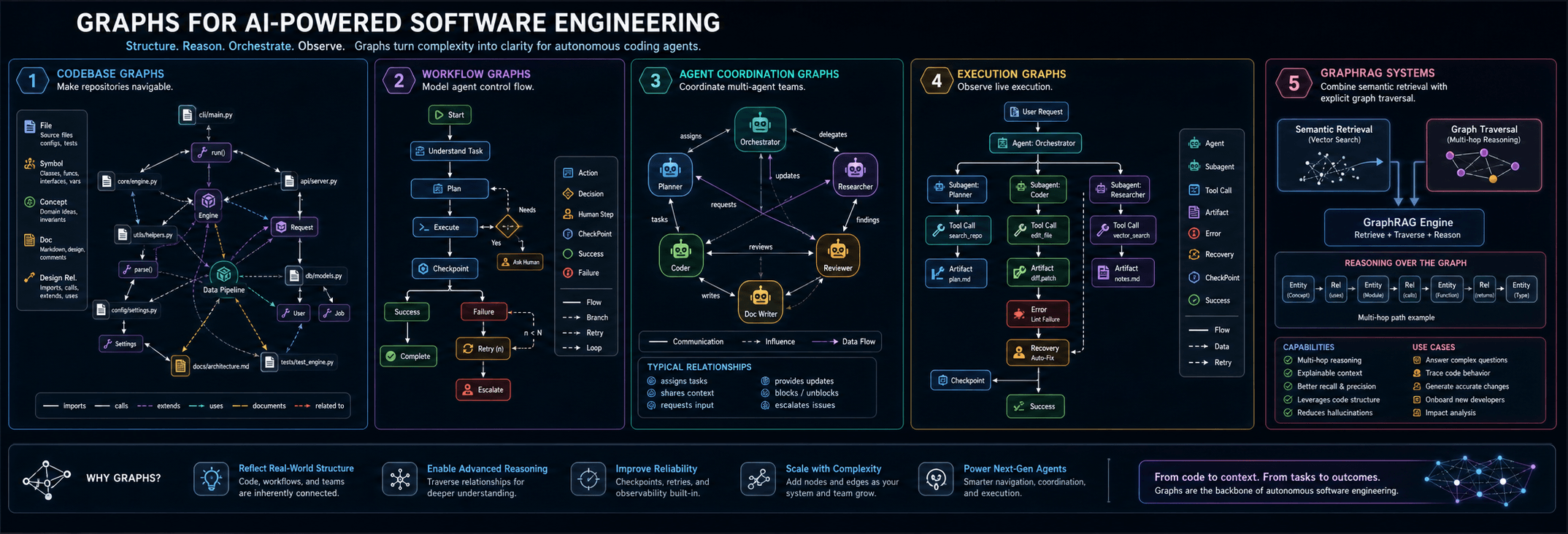
In agentic AI engineering, a graph is more than a visualization. It is an explicit structure over code, tools, agents, documents, memory, or execution state. That structure gives agents something loops and vector search alone do not provide: durable relationships, controllable transitions, and inspectable reasoning paths.
The pattern is showing up across the stack. Coding agents use codebase graphs as persistent maps. Agent runtimes use state graphs to make workflows recoverable. Multi-agent systems use communication graphs to route influence. RAG systems combine vector search with knowledge graph traversal. Agent development environments quietly maintain task and tool graphs under the hood.
The result is a shift from "let the model loop until it works" toward systems where engineers can design, inspect, resume, and debug the shape of agent behavior.
The short version
Graphs matter in agentic AI because they turn implicit context into explicit structure:
- Codebase graphs: Represent files, symbols, concepts, docs, and design relationships so coding agents can navigate a repo without repeatedly rediscovering it.
- Workflow graphs: Represent agent control flow as nodes and edges, with branching, checkpoints, retries, and human review.
- Agent coordination graphs: Represent agents as nodes and communication or influence paths as edges.
- Execution graphs: Represent the live trajectory of tasks, tool calls, subagents, artifacts, failures, and recovery steps.
- GraphRAG systems: Combine semantic retrieval with explicit entity and relationship traversal for multi-hop reasoning.
This does not mean every agent needs a full graph database. It means serious agent systems increasingly need some graph-shaped representation of what they know, what they are doing, and how work moves through the system.
Codebase graphs: repo memory for coding agents
The most immediate use case is the codebase graph.
A coding agent operating over a large repository has to answer questions like:
- Where is this behavior implemented?
- Which components call this function?
- Which docs explain the rationale?
- Which files changed together historically or conceptually?
- Which symbols are factual dependencies versus semantic guesses?
Without a graph, the agent falls back to repeated search, file reads, embeddings, and short-lived context. That works for small tasks, but it becomes brittle in long-running sessions or unfamiliar repos.
Graphify is one example of this direction. It turns a mixed project folder containing code, markdown, PDFs, images, audio, and video into a queryable knowledge graph for coding agents such as Claude Code, VS Code Copilot Chat, Cursor, and similar tools. It builds nodes for files, symbols, concepts, and documents. It builds edges for calls, references, design decisions, and rationale. It then exports artifacts such as graph.html, GRAPH_REPORT.md, persistent graph.json, and an incremental cache.[1][2][7][27]
The important design detail is not just that relationships exist. It is that edges can be labeled. A graph can distinguish extracted facts from inferred or ambiguous semantic links. That distinction matters because agents should reason differently over "this function calls that function" than over "these two files seem conceptually related."
For coding agents, this makes the repo less like a pile of text chunks and more like a map.
Workflow graphs: agent loops become state machines
The second major use is runtime control.
Classic agents are often described as loops: reason, choose a tool, observe the result, repeat. That pattern is simple, but it hides too much. Branches, retries, state updates, interrupts, and failures all happen inside an opaque loop.
LangGraph makes the graph explicit. It models long-running, stateful workflows as graphs or state machines. Each node is a runnable, often an LLM-powered agent or tool. Each edge encodes a state transition, conditional branch, or continuation path.[3][4][8][9][11][12][25]
This changes how agent systems are designed:
- Durable execution: State can be checkpointed and resumed instead of lost when a run fails.
- Human-in-the-loop control: A person can inspect or edit state at specific points in the graph.
- Composable subgraphs: Multi-step behavior can be packaged and reused.
- First-class retries and fallbacks: Error handling becomes part of the workflow design rather than a hidden exception path.
- Observability: Tools such as LangSmith can visualize the run, state transitions, and intermediate decisions.[10]
The point is not that graphs are fashionable. The point is that long-running agents need recoverable control flow. A graph is a practical way to make that control flow explicit.
Graphs of agents: coordination as topology
Graphs also show up when the system contains multiple agents.
In a graph-of-agents design, each agent is a node. Edges represent communication, influence, dependency, or message passing. Instead of assuming every agent talks to every other agent, the system can define or learn a topology.
Research such as Graph-of-Agents treats LLM agents as graph nodes and constructs directed edges based on response relevance. The system can sample agents based on model-card-like descriptions, compare their outputs, route messages through directed edges, and pool results into a final answer.[13]
Related work in multi-agent reinforcement learning uses implicit coordination graphs to represent latent dependency structures between agents. The point is similar: coordination improves when the system has some representation of who depends on whom, who should influence whom, and which interactions matter.[14]
For practical agent engineering, this suggests a useful design question: should coordination be a chat room, a hierarchy, a DAG, a tree, or a dynamic graph?
A flat group chat is easy to build, but it becomes noisy. A manager-worker tree is controllable, but it can bottleneck. A graph lets the engineer or runtime route information through the structure that best matches the task.
ADEs and control centers: implicit execution graphs
Agent development environments often use language like "flows," "tasks," "runs," or "sessions." Underneath, many of them maintain an execution graph.
A controller has to track:
- Which agent spawned which subagent
- Which tools were called and in what order
- Which artifacts were produced
- Which tasks depend on other tasks
- Where errors occurred
- Which branch or recovery path was taken
Even if the product UI does not say "graph," the runtime often behaves like a DAG or cyclic state graph. This is why visual execution traces are so useful. They show the actual shape of work: branches, loops, failed paths, retries, handoffs, and final outputs.[3][10]
For engineers, this is the difference between reading a transcript and debugging a system. A transcript says what happened. A graph shows how the work moved.
GraphRAG: memory needs relationships, not just similarity
The memory layer is where graph language is now unavoidable.
Vector databases are excellent at semantic similarity. They can answer "which chunks are near this question in embedding space?" But they struggle with explicit multi-hop relationship queries:
- Which company acquired the startup that built this product?
- Which services depend on the library that introduced this vulnerability?
- Which design decision caused this later migration?
- Which entities connect these two documents?
Graph databases are strong at entities and relationships, but weaker at fuzzy natural language matching. GraphRAG and HybridRAG combine the two: vector search finds semantically relevant chunks or entities, graph traversal explores relationships, and the agent reasons over both.[5][6][15][16][18][19][21][29]
This hybrid approach is especially useful for questions that require global summarization, multi-hop reasoning, provenance, or factual consistency. Benchmarks and system designs increasingly show that pure vector retrieval is not enough for complex enterprise and agentic workloads.[15][16][19]
Hybrid relational-graph-vector databases push this further. Systems such as CozoDB, TigerGraph, and Memgraph market combinations of relational tables, graph structures, and vector search for advanced RAG and agentic workloads.[6][17][20]
The underlying lesson is simple: similarity is not the same thing as structure.
The terms you will keep seeing
Here is the practical vocabulary:
| Term | What it usually means | Why it matters |
|---|---|---|
| Codebase graph | Files, symbols, docs, concepts, and relationships in a repo | Gives coding agents durable project memory |
| Knowledge graph | Entities and relationships across documents or domains | Supports provenance and multi-hop reasoning |
| State graph | Nodes and transitions in an agent workflow | Makes execution controllable and recoverable |
| Workflow graph | A designed graph of tasks, tools, branches, and fallbacks | Replaces hidden loops with inspectable control flow |
| Graph-of-agents | Agents as nodes, communication as edges | Makes multi-agent coordination explicit |
| Execution graph | The observed trajectory of agents, tools, artifacts, and errors | Helps debug real runs |
| GraphRAG | RAG that combines graph traversal with retrieval | Improves relational grounding beyond vector search |
| Hybrid graph-vector DB | A store combining graph, vector, and sometimes relational models | Supports agent memory and analytics in one system |
How this changes agent design
The practical design shift is from prompt-centered agents to structure-centered agents.
Instead of asking only "what prompt should the model follow?" engineers increasingly ask:
- What graph should the agent operate over?
- Which relationships are factual, inferred, or ambiguous?
- Which state transitions are allowed?
- Where can a human inspect or edit state?
- Which subagents should communicate directly?
- When should retrieval use similarity, graph traversal, or both?
- How do we visualize the run after something fails?
This does not remove the LLM from the center. It gives the LLM a more reliable substrate.
A naive loop asks the model to rediscover structure every turn. A graph-backed system preserves structure between turns, runs, agents, and tools.
A useful mental model
Think of graphs as the control plane and memory fabric for agents.
They do four jobs:
- Map: They show what exists and how it connects.
- Constrain: They define allowed paths, dependencies, and transitions.
- Remember: They preserve relationships across sessions and runs.
- Explain: They make execution and reasoning easier to inspect after the fact.
That is why "graph" now appears in codebase indexing, LangGraph-style orchestration, multi-agent research, ADE execution traces, and GraphRAG memory systems. These are not separate trends. They are different responses to the same pressure: agent systems need durable structure.
Sources
[1] Codebase Graphs Are the New Agent Map - Developers Digest
[2] Graphify: Bringing Knowledge Graphs to AI-Assisted Engineering
[3] LangGraph GitHub repository
[4] LangGraph: Agent Orchestration Framework for Reliable AI Agents
[5] Combining Knowledge Graphs and Vector Search for Agentic Memory
[6] HybridRAG and Why Combine Vector Embeddings with Graph Databases
[7] How Graphify Works: Concepts
[8] Introducing LangGraph: Build Dynamic Multi-Agent Workflows for LLMs
[9] Introducing LangGraph: A Framework for Stateful, Multi-Agent AI Workflows
[10] Observability With LangSmith
[11] What is LangGraph?
[12] Building Agentic Workflows with LangGraph and Granite
[13] A Graph-based Framework for Multi-Agent LLM Collaboration
[14] Deep Implicit Coordination Graphs for Multi-agent RL
[15] Benchmarking Vector, Graph and Hybrid Retrieval
[16] Vector Databases vs. Knowledge Graphs for RAG
[17] The Hybrid Relational-Graph-Vector Database
[18] HybridRAG GitHub repository
[19] Supporting Vector Search in Graph Databases for Advanced RAGs
[20] Next Generation Hybrid Search with Graph and Vector
[21] Hybrid RAG in the Real World
[22] Hybrid Vector-Graph Relational Vector Database discussion
[23] Building Production-Ready AI Agents with LangGraph and Amazon Bedrock AgentCore
[24] LangGraph mirror: Build resilient language agents as graphs
[25] How to Build LangGraph Agents: Hands-On Tutorial
[26] Agent AI with LangGraph: A Modular Framework for Applications
[27] How to Use Graphify to Build a Queryable Knowledge Graph
[28] HybridRAG: A Fusion of Graph and Vector Retrieval
[29] Beyond Simple Retrieval: A Hybrid Graph-Vector RAG System
[30] MyAG: A Graph-Based Framework for Designing and Understanding Agent Systems