
Vibe Coding vs Agentic Engineering
The rapid maturation of autonomous AI agents has triggered a paradigm shift in software development. Explore the difference between Vibe Coding and Agentic Engineering, and why disciplined AI orchestration is the future of Software 3.0.
The traditional Software-as-a-Service (SaaS) model, characterized by per-seat pricing, human-centric interfaces, and the protective "code moat", is being fundamentally dismantled. The rapid maturation of autonomous AI agents has triggered a paradigm shift, giving rise to two defining philosophies in the developer zeitgeist: "Vibe Coding" and "Agentic Engineering".
While one is a dangerous illusion for production systems, the other is the rigorous blueprint for the future of our industry.
The Evolution to Software 3.0
To understand this shift, we have to look at how the biology of software is changing: how it is born, distributed, and monetized.
Software 1.0 was characterized by human-written, deterministic code (C++, Java, Python). Software 2.0 was defined by neural network weights and machine learning models trained on vast datasets. Software 3.0 is here. Large Language Models (LLMs) function as the primary computing engine, and natural language prompts act as the code.
Because of this, the industry is witnessing the birth of “Service-as-Software” (SaS). In the traditional SaaS model, you bought a tool for a human to do work (e.g., a CRM for a sales rep). In the SaS paradigm, the product is no longer a tool; it is an autonomous outcome delivered directly by an agent. You don't buy software to manage your workflow; you buy an agentic system that executes the workflow for you.
The Trap of "Vibe Coding"
With the barrier to entry for software creation dropping to zero, "Vibe Coding" (a term popularized by AI researcher Andrej Karpathy) became a massive trend. Vibe coding is the free-form practice of loosely prompting an AI, accepting the generated code without fully reviewing or understanding it, and hoping the application holds together through sheer luck.
Let’s be clear: Vibe coding is a bad idea for production.
If you are building a throwaway weekend prototype or learning a new framework, vibe coding is magic. But if you want production-grade, secure, and highly accurate applications, relying on "vibes" leads directly to unmaintainable spaghetti code, security vulnerabilities, and catastrophic edge-case failures when the LLM's context window overflows.
The Reality: Agentic Engineering
The antidote to Vibe Coding is Agentic Engineering.
Agentic Engineering recognizes a hard truth: you still need a really good software engineer at the wheel. The difference is that the engineer's day-to-day work has fundamentally transformed.
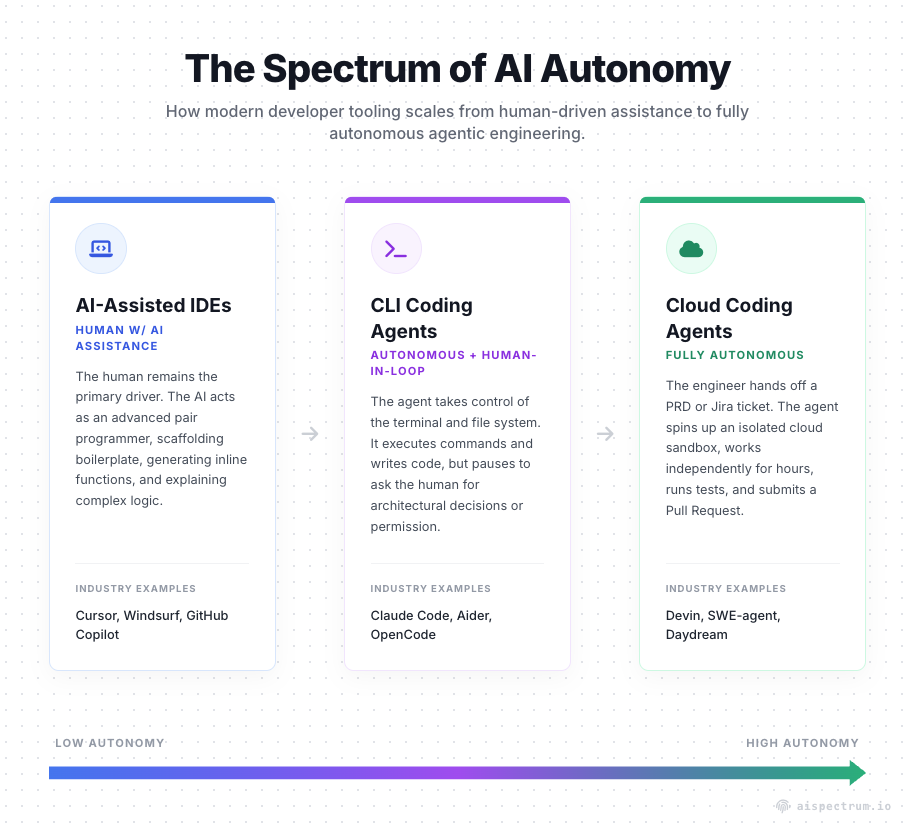
The software engineer is no longer a syntax-typist. They are now a Technical Engineering Manager operating a fleet of AI tools. Armed with AI-assisted IDEs (like Windsurf and Cursor) and CLI agents (like Claude Code and OpenCode), the engineer orchestrates complex systems. They still write code, but it is minimal, highly strategic, and focused on architecture, test-driven constraints, and system alignment.
The Spectrum of Autonomy
Agentic Engineering operates on a spectrum of autonomy, managed by the engineer:
1. Hybrid Autonomy (Human-in-the-Loop)
The engineer and the AI work in tandem. The AI generates boilerplates, refactors components, and writes tests, but the engineer reviews, steers, and approves the logic at critical junctures. The human provides the conceptual system-thinking that the AI lacks.
2. Full Autonomy & The "Ralph Loop"
For well-defined tasks, engineers are deploying fully autonomous agentic work managers. A perfect example of this is the viral "Ralph Loop" technique.
Long-running AI chats suffer from "context rot": the longer the chat, the more the AI hallucinates and forgets instructions. A Ralph loop is a ruthless context-reset mechanism (often just a simple Bash while loop). It spins up a fresh AI agent, feeds it a Product Requirements Document (PRD) and maybe an SRD if opinionated by the Human Engineer, and tells it to pick one task. The agent writes the code, runs the tests, and commits to Git. If the tests fail, the loop catches it. Because the state is saved in the file system and Git history rather than the LLM's fragile memory, the agent can run overnight, continuously iterating until the entire test suite passes.
This isn't "vibing." This is deterministic, test-driven, autonomous engineering.
The Takeaway
The transition to Software 3.0 doesn't eliminate the software engineer; it elevates them.
If you treat AI as a magic wand to "vibe" your way into a codebase, you will build fragile toys. But if you adopt the discipline of Agentic Engineering (treating AI agents as highly capable, autonomous reports that require architectural guidance, ruthless testing, and structured loops) you will build the robust, outcome-driven "Service-as-Software" platforms of tomorrow.
The code moat is gone. The execution moat is what matters now.
Sources & Resources
- Andrej Karpathy on "Vibe Coding": Karpathy popularized the term in early 2025 to describe the emerging behavior of writing software entirely through natural language without interacting with the underlying syntax.
- HFS Research & Phil Fersht: Coined and popularized the transition from traditional SaaS to "Service-as-Software" (SaS), highlighting the shift toward autonomous AI outcomes.
- Geoffrey Huntley & The Ralph Loop: The creator of the "Ralph" methodology, demonstrating how to beat LLM "context rot" by using deterministic Bash loops to spin up fresh, single-task agents that self-correct via test-driven development.
- Simon Willison's Weblog & Addy Osmani: Leading voices advocating for the shift from casual "vibe coding" to disciplined Agentic Engineering, emphasizing the software engineer's new role as an AI orchestrator and technical manager.